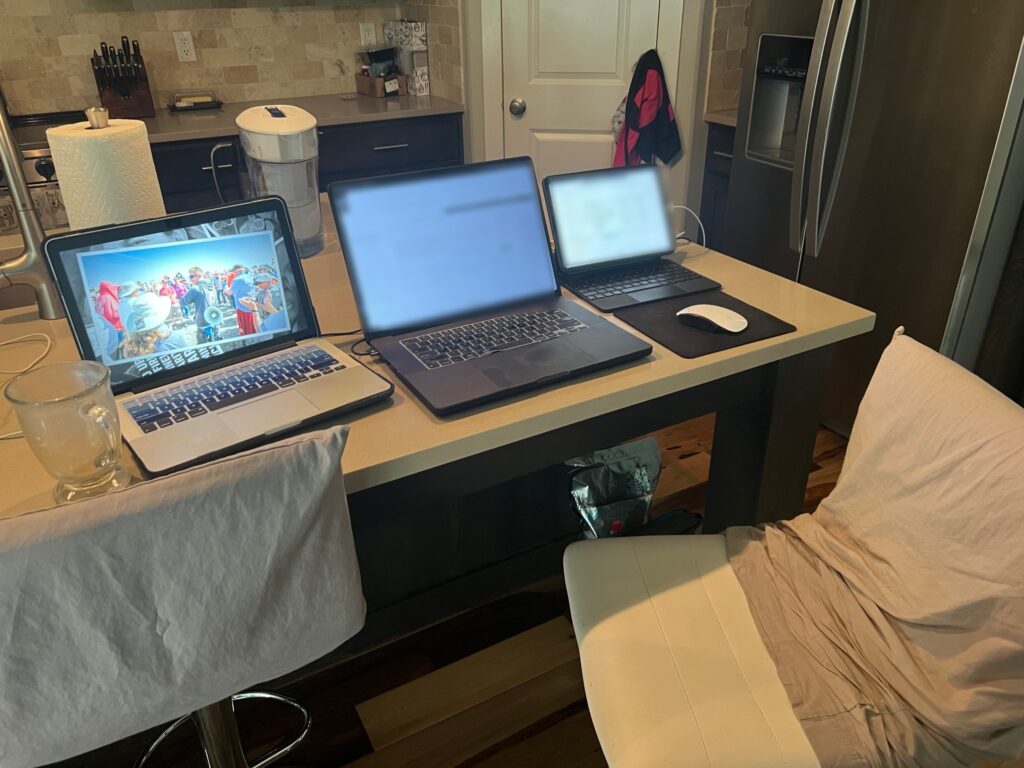
For the past few days, this kitchen counter has been KiteLife headquarters.
Some backstory. Mike Gillard and I flew together on Captain Eddie’s Flying Circus in the late ’90s. In 1996 he invited me to practice with his team, and he’s a big part of why I came back to kiting at all. In 1998 he started KiteLife as a free online magazine, just as the printed kite magazines were disappearing.
In 2001 I started collecting sport kite competitor bios on a little site called Satori Kites, and that brought us back in touch. Late in 2002, with Mike busy editing the AKA’s Kiting magazine, he asked me to carry KiteLife on as webmaster. In 2003 he handed it over to me outright.
Until then I was mostly a performer and competitor. KiteLife was my first real move into community work, and my first step toward being able to at least survive through the kite community.
Mike passed suddenly in 2006, at 51. I still live by a phrase he used often: “It’s just kites, man.”
It was never him brushing kites off. However serious it gets, however deep we go, “it’s just” is a state of mind. It’s peace, and love for the thing, even under all the seriousness we humans wrap around what we care about.
From there KiteLife kept growing. We added a forum, a video archive of competition routines before YouTube was common, and subscriber prize drawings. We also built complete archives of three out-of-print magazines, Kite Lines, Stunt Kite Quarterly and Sportkite News, with every page hand-scanned. All of it is free to read.
🔥 kitelife.com
🔥 kitelife.com/forum
Then there are the tutorials. Up until 2012, we produced close to 50 instructional videos under the KiteLife name. They’re all still there, and many of them are still benchmark references for the community today.
More than half are free to watch. The rest sit behind the KiteLife subscription, as thanks to the people who support KiteLife’s day-to-day operations.
The world around it changed, too. People read differently now. Long-form articles and event reports gave way to quick posts, short videos and scrolling feeds. Much of the conversation moved to social media, where it moves fast and disappears just as fast.
The kite community got smaller, and fewer new writers and reporters came along to tell its stories. By 2013 it was getting hard to find new authors, and in 2015 we stopped publishing new articles on KiteLife. The last ones went up in 2014. Nothing broke. The culture shifted, and so did our community.
The last couple of years, KiteLife went quieter than I’d like.
These last few days, it’s come back up for air. Years of subscription records have been rebuilt, one at a time. The forum is now on a new platform. Every page of the site has been checked, and hundreds of archive articles have been repaired, sorted and given images.
Twenty issues from 1999 to 2002, missing since the site’s first major overhaul in the mid-2000s, are being restored: more than 380 articles and 2,000 images. The prize drawings for our paying subscribers and supporters are back.
Those paid subscriptions are KiteLife’s only revenue. Their support eked me through some especially hard years before I started Kite Forge. Even with fewer active subscriptions today, they still pay the bills that keep this huge resource online, alive and well, and ready for whatever it becomes next.
If KiteLife has meant something to you, this is the way to keep it going. Subscribers have received more than $43,000 in prizes since February 2003, as thanks for their paying support.
To give a sense of the scale: KiteLife holds 1,624 articles from more than 80 issues of its own magazine. It also holds every issue of Kite Lines (50 issues, 1977–1999) and Stunt Kite Quarterly (13 issues, 1988–1993), plus Sportkite News (1994–1997). The forum adds close to 10,000 topics and more than 79,000 posts from fliers around the world.
Together that’s kite writing, photos and conversation going back to 1977, all in one place. We’ve said for years that it’s the largest collection of kiting material online, and I still haven’t found anything that comes close.
Many, many hands: the people who wrote articles and sent in photos, the ones who stepped in as editors, the moderators who’ve kept the forum a good place to be, and everyone who pitched in however they could. It’s a collective work, built from the passion and good will of a lot of people.
A special nod to Dave “Geezer” Shattuck and David Hathaway, who spent countless days over the years, at different times, working behind the scenes as full co-editors: writing, gathering material from authors, preparing and editing it, and helping manage the website.
Going through it all, what stays with me is how much is there, saved for posterity when we as a community lose more institutional memory every year than we gain. Nearly fifty years of people writing about something they love, and it’s still all readable. (mic drop)
Were you around for the old KiteLife days? Maybe you waited for the next issue to come out, learned your first moves from one of the tutorials, or traded tips in the forum late into the night. What stuck with you?
And the bigger question: KiteLife has a long past, but its future is wide open. Kiting doesn’t need another feed. So what could KiteLife be for you now? An archive, a classroom, a gathering place, or something none of us has thought of yet?
– JB